19:00 até às 22:00
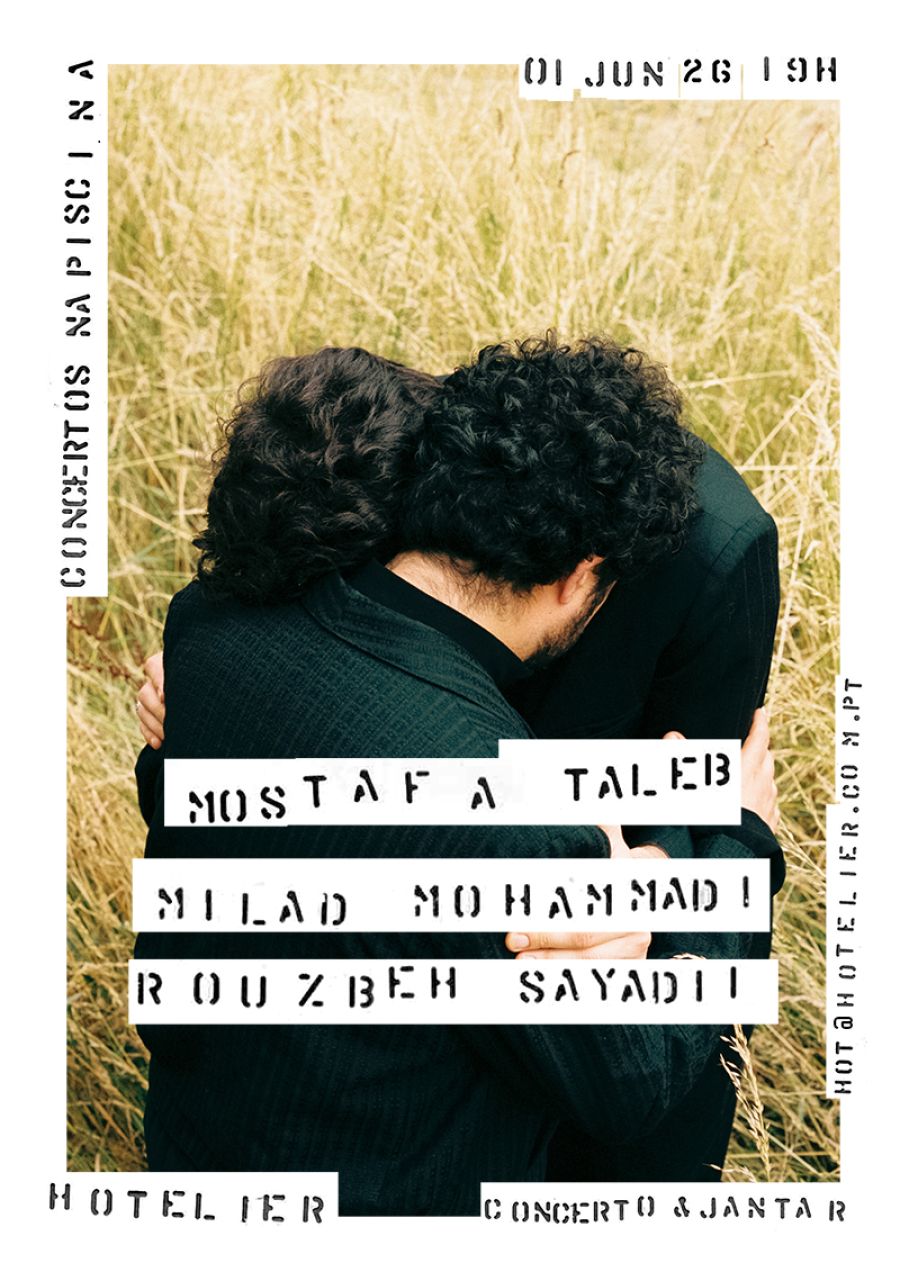
CONCERTOSNAPISCINA 118# - Mostafa Taleb / Milad Mohammadi / Rouzbeh Sayadii
5€ - 10€
https://www.hotelier.com.pt/concertosnapiscina/concertosnapiscina-117-2/
O mundo dele é como uma montanha.
O seu eco depende de si.
Se gritar coisas boas,
o mundo retribuirá.
Se gritar coisas más,
o mundo retribuirá.
Mesmo que alguém fale mal de si,
fale bem dele.
Mude o seu coração para mudar o mundo.
— Shams Tabrizi (1185 – 1248)
SETÂR
Um dia, Shams
entrou na assembleia de Rumi, onde Rumi discursava. Nessa altura, Rumi
já era um teólogo famoso. Shams reparou nos livros que estava a estudar e
perguntou: “O que são estes?”
Rumi respondeu com desdém: “Algo que os ignorantes não conseguem compreender.”
Shams pegou nos livros e atirou-os para o rio próximo.
Rumi disse: “Ó Darvish, alguns destes livros são recordações do meu pai, exemplares únicos e raros!”
Shams Tabrizi mergulhou a mão na água e recuperou os livros. Permaneceram completamente secos…
Rumi perguntou, surpreendido: “Qual é esse segredo?!”
Shams
respondeu: “Algo que os estudiosos não conseguem compreender”. E
acrescentou: “Procurai o conhecimento que nenhuma água pode apagar – o
conhecimento do vosso coração…”
Este episódio foi o ponto de partida
de uma nova vida para Rumi, que morreu para si próprio e encontrou um
novo nascimento nas trocas espirituais que teve com Shams. Abandonou
todos os seus cargos como homem de fé respeitado e conhecido, e
voltou-se para o misticismo, a poesia, a dança e a música, tornando-se
um dos mais importantes poetas persas. Inspirado pelo encontro
transformador entre Jalāl ad-Dīn Rūmī (Mowlana) e Shams Tabrizi, este
projeto apresenta uma viagem musical que culmina num concerto.
Mais do que um recital convencional, o concerto é concebido como uma experiência artística imersiva que reúne
a música e a poesia persas, refletindo a profundidade espiritual e cultural desta tradição.
“Setâr”
é concebido como um profundo encontro artístico, e não como uma simples
apresentação. Através da interação entre música e inspiração poética, o
projeto procura evocar a mensagem intemporal atribuída a Shams: “Search
o conhecimento que nenhuma água pode apagar — o conhecimento do seu
coração”.
Através desta viagem musical, Mostafa Taleb, Milad
Mohammadi e Rouzbeh Sayadii pretendem partilhar a alma viva da cultura
persa com o público europeu, criando uma ponte significativa entre as
tradições e culturas.
Mostafa Taleb, nascido na
província iraniana de Lorestan, começou a aprender o kamancheh, um
instrumento ancestral de cordas friccionadas, ainda jovem. Formado pela
Academia de Folclore Azar Mehr em Khorramabad e pela Academia Kamkarha
de Música Clássica Persa em Teerão, chegou a Bruxelas em 2016.
O seu
talento e extraordinária personalidade musical permitiram-lhe superar as
dificuldades do exílio e estabelecer uma sólida reputação como
intérprete, improvisador e compositor. Na Europa, abriram-se-lhe as
portas: a convite do lendário maestro Jordi Savall, participou inúmeros
concertos por toda a Europa com o ensemble Orpheus XXI. Com o projeto
“Egged on” da Cinemaximiliaan
Silent Film Music, Mostafa fundou
vários grupos musicais inovadores, sempre inspirados pela música persa,
como os conjuntos Hamnava e Illumination.
Em 2016, compôs e
improvisou para o quinteto de cordas “About that magic circle” e para o
filme “Always there is no one”, de Mansur Azizi. Em 2018, colaborou com
Simon Ho (Suíça) para compor a música de um filme mudo no Festival de
Cinema Mudo de Ghent (Bélgica). Entrando no mundo do teatro, em 2019
juntou-se ao elenco da audaciosa peça de Lisaboa Houbrechts, “Bruegel”,
para a qual compôs a música. Juntamente com o cravista e organista
Jérôme Bertier e os cantores do coro Harmonia Sacra, o ensemble de
Bruegel já foi apresentado por toda a Europa. As trocas literárias e
musicais entre Mostafa e Jérôme Bertier levaram-nos a criar o conjunto
Ârgha/Nun, cujo ponto em comum é um diálogo entre a Europa e a Pérsia.
Milad Mohammadi,
nascido em 1988 no Irão, é um tocador de tar e multi-instrumentista.
Iniciou os seus estudos musicais aos 12 anos na conceituada Escola de
Música de Teerão, onde se formou em 2005. Possui também um diploma em
música iraniana pela Universidade de Música de Teerão. Na cerimónia de
encerramento do 8º Festival da Juventude em 2014, no Irão, o jovem
músico conquistou o primeiro lugar na categoria “Música de Tar”. A
partir de 2012, gravou inúmeros álbuns: o seu primeiro álbum
instrumental, Shadow, foi lançado em 2012, seguido de The Metamorphosed
em 2014. Colaborou com alguns dos maiores músicos iranianos, entre os
quais Hoshyar Khayyam, com quem lançou Music for Tar and Piano (um álbum
campeão de vendas no Irão, premiado como o melhor álbum de fusão
instrumental em 2018), Alireza Ghorbani pelo álbum Blaze e o lendário
Homayoun Shajarian pelo álbum Rag Khab. Compôs também Taroud, uma peça a
solo que introduziu um novo estilo de música iraniana. Para além do
seu amplo conhecimento de música persa clássica e tradicional, Milad
Mohammadi procura constantemente romper com as fronteiras estilísticas e técnicas.
Rouzbeh Sayadii
is a musician and composer with more than twelve years of dedicated
training in the tar and setar under respected masters of Persian
classical music. He specializes in improvisational performance grounded
in the Persian radif tradition as well as contemporary composition. His
experience includes solo performance, ensemble leadership, and the
creation of original music for large-scale theatrical productions. He is
currently seeking professional representation to support the
organization and performance of concert
tours across Europe and internationally.
He
holds a Bachelor’s degree in English Language and Literature. His
formal studies in Persian classical music began in November 2012. In
recent years, he has worked closely with Mohammad Ali Najafpour
(composition and theory, 2022–present) and Maysam Zahed (radif and
advanced studies, 2024–present). His tar training has also been shaped
by Alireza Khoshrouei and Pouria MohammadNejad in Gorgan, as well as
Hadi Azarpira, Eisa Ghaffari, and Kiarash Rouzbehani in Tehran. Earlier
in his musical development, he studied setar with
Kourosh Yaghmaei and also learned from Davood Khoshnoudi and Babak Khademloo.
As
a performer, Sayyad appeared at the Museum of Contemporary Art, Tehran,
in November In February 2020, he performed with the YARAVA Modern
Orchestra at the University of Tehran’s Contemporary Music Concert. He
has also led and performed in multiple concerts in Gorgan, Iran, in 2019
and 2023.
~~~~~~~~~~~~~~~~~~~
his world is like a mountain.
Your echo depends on you.
If you scream good things,
the world will give it back.
If you scream bad things,
the world will give it back.
Even if someone says badly about you,
speak well about him.
Change your heart to change the world.
— Shams Tabrizi (1185 – 1248)
SETÂR
One day Shams entered Rumi’s assembly, where Rumi was giving a speech. At that time, Rumi was already a
famous theologian. Shams noticed the books that he was studying and asked: “what are these?”
Rumi answered with contempt: “Something that the ignorants cannot understand.”
Shams took the books and threw them into the nearby river.
Rumi said: “O Darvish, some of these books are my father’s souvenirs and unique and rare copies!”
Shams Tabrizi dipped his hand in the water and took the books back. They had remained completely dry…
Rumi asked, astonished: “what is this secret?!”
Shams
answered: “Something that the scholars cannot understand”. And he
added: “Look for the knowledge that no water can erase – the knowledge
of your heart…”
This episode was the starting point of a new life for Rumi, who died to himself and found a new birth in the
spiritual exchanges he had with Shams. He left all of his positions as a respected and well-known man of faith,
and turned to mysticism, poetry, dance and music, becoming one of the most important Persian poets.
Inspired by the transformative encounter between Jalāl ad-Dīn Rūmī (Mowlana) and Shams Tabrizi, this project
presents a musical journey culminating in a concert performance.
More than a conventional recital, the concert is conceived as an immersive artistic experience that brings
together Persian music and poetry, reflecting the spiritual and cultural depth of this tradition.
“Setâr” is envisioned as a deep artistic encounter rather than a simple performance. Through the interplay of
music and poetic inspiration, the project seeks to evoke the timeless message attributed to Shams: “Look for
the knowledge that no water can erase — the knowledge of your heart.”
Through this musical journey, Mostafa Taleb, Milad Mohammadi, and Rouzbeh Sayadii aim to share the living
soul of Persian culture with European audiences, creating a meaningful bridge between traditions and
cultures.
Mostafa Taleb, born in
the Iranian province of Lorestan, started to learn the kamancheh, an
ancestral bowed-string instrument, at an early age. A graduate of the
Azar Mehr Folklore Academy in Khorramabad and the Kamkarha Academy for
Classical Persian Music in Teheran,
he arrived in Brussels in 2016.
His talent and extraordinary musical personality enabled him to overcome
the difficulties of exile and establish a solid reputation as a
performer, improviser and composer. In Europe,
doors opened for him:
invited by the legendary conductor Jordi Savall, he took part in
numerous concerts across Europe with the Orpheus XXI ensemble. With the
Cinemaximiliaan Silent Film Music’s “Egged on” project, Mostafa founds
several innovative music groups, always inspired by Persian music, such
as the Hamnava and Illumination ensembles. In 2016, he composed and
improvised for the string quintet “About that magic circle” and for the
film “Always there is no one” by Mansur Azizi. In 2018, he collaborated
with Simon Ho (Switzerland) to compose the music for a silent film at
the Silent Film Festival in Ghent (Belgium). Entering the world of
theater, in 2019 he joined the cast of Lisaboa Houbrechts’ audacious
play, “Bruegel”, for which he composed the music. Along with
harpsichordist and organist Jérôme Bertier and the singers of the
Harmonia Sacra choir, the Bruegel set has since played all over Europe.
Mostafa and Jérôme Bertier’s literary and musical exchanges lead them
to create the Ârgha/Nun ensemble, whose common ground is a dialogue between Europe and Persia.
Milad Mohammadi,
born in 1988 in Iran, is a tar player and multi-instrumentalist. He
began his music studies at the age of 12 at the renowned Tehran Music
School, from which he graduatedin 2005. He also holds a degree in
Iranian music from the University of Music in Tehran. At the closing
ceremony of the 8th Youth Festival in 2014 in Iran, the young musician
won first place in the “Tar music” category. Starting in 2012, he
recorded numerous albums: his first instrumental album, Shadow, was
released in 2012, followed by The Metamorphosed in 2014. He collaborated
with some of the greatest Iranian musicians, including Hoshyar Khayyam,
with whom he released Music for Tar and Piano (a top-selling album in
Iran, awarded the best instrumental fusion album in 2018),
Alireza
Ghorbani for the album Blaze, and the legendary Homayoun Shajarian for
the album Rag Khab. He also composed Taroud, a solo piece that
introduced a new style of Iranian music. In addition to his extensive
knowledge of classical and traditional Persian music, Milad Mohammadi
constantly seeks to break free from stylistic and technical boundaries.
Rouzbeh Sayadii
is a musician and composer with more than twelve years of dedicated
training in the tar and setar under respected masters of Persian
classical music. He specializes in improvisational performance grounded
in the Persian radif tradition as well as contemporary composition. His
experience includes solo performance, ensemble leadership, and the
creation of original music for large-scale theatrical productions.
He is currently seeking professional representation to support the organization and performance of concert
tours
across Europe and internationally. He holds a Bachelor’s degree in
English Language and Literature. His formal studies in Persian classical
music began in November 2012. In recent years, he has worked closely
with
Mohammad Ali Najafpour (composition and theory, 2022–present)
and Maysam Zahed (radif and advanced studies, 2024–present). His tar
training has also been shaped by Alireza Khoshrouei and Pouria
MohammadNejad in Gorgan, as well as Hadi Azarpira, Eisa Ghaffari, and
Kiarash Rouzbehani in Tehran.
Earlier in his musical development, he
studied setar with Kourosh Yaghmaei and also learned from Davood
Khoshnoudi and Babak Khademloo. As a performer, Sayyad appeared at the
Museum of Contemporary Art, Tehran, in November In February 2020, he
performed with the YARAVA Modern Orchestra at the University
of Tehran’s Contemporary Music Concert. He has also led and performed in multiple concerts in Gorgan,
Iran, in 2019 and 2023.
~~~~~~~~~~~~~~~~~~~~~~~~~~~~~~~
Donativo para os músicos – 5 a 10 euros.
Para quem quiser, há jantar (vegano) – 7,50 euros.
Lotação limitada. Reserva aconselhada.
Os concertos no hotelier são promovidos pelos próprios artistas para divulgação do seu trabalho.
Os donativos na sua totalidade, são a única retribuição, pelo que se agradece a generosidade
de quem possa e queira dar um pouco mais.
Donation to musician – 5 to 10 euros.
Anyone who wants to stay for dinner (vegan) – 7,50 euros.
Limited seating. Reservation advised.
Concerts at the hotelier are promoted by the artists themselves to show their work.
Donations are the only retribution, so we are grateful for the generosity of those who
can and want to give a little more.
reservas: hot@hotelier.com.pt
Recomendamos que confirme toda a informação junto do promotor oficial deste evento. Por favor contacte-nos se detectar que existe alguma informação incorrecta.