16:00
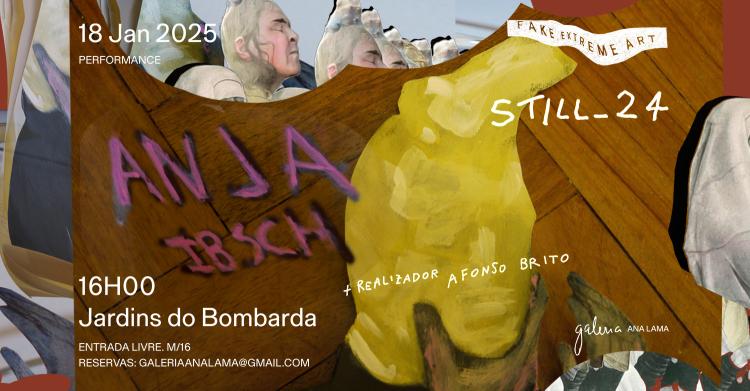
Anja Ibsch no Fake Extreme Art: STILL_24
PT
Apresentamos a performance STILL_24, de Anja Ibsch, em Lisboa, integrada no ciclo FEA (Fake Extreme Art).Anja Ibsch tem desenvolvido trabalho como artista e curadora nas áreas da performance e da instalação desde 1993. Explora uma dimensão que para si é sempre nova: uma dimensão em que o corpo humano está realmente integrado num ambiente. As suas performances contêm aspetos autobiográficos, mas também culturais e sociais. Frequentemente inspirada em mitos de santidade, sacrifício e libertação, a artista alemã enfatiza e expande as conexões entre o seu corpo e a terra, testando os limites físicos de tensão e tolerância. Entre os atos mais marcantes destacam-se a ingestão de pó, a transformação da pele em terreno de nidificação para vermes e deixar gelo derreter sobre os olhos.
A abordagem artística de Ibsch adapta-se a cada contexto, respondendo às especificidades do espaço e da circunstância em que atua.
O crítico Paul Hudson, especializado em Artes Visuais e Performance, afirma que, nas suas instalações acionadas, na génese dos processos de Anja Ibsch, há uma exacerbação tal do momento interior que a própria subjetividade entra em crise.
«Isso faz com que quem contempla uma performance sua entre no espírito da catarse e procure um novo equilíbrio, equilíbrio trazido pela recuperação dos objetos não ao nível psicológico, mas na esfera da sua própria e irredutível realidade. Falamos do contraste entre o seu corpo e a matéria, muitas vezes criando situações com objetos invulgares encontrados ou provenientes de antiquários, que se organizam numa dimensão instalativa.»Para Hudson, trata-se de um salto do psicológico para o metafísico. Vê também, nas ações da autora, exemplos das crises no seio das artes visuais: a crise da personagem-ego como produtor autor de objetos, refletindo sobre a ideia do artista enquanto marca ou logótipo, cunho de um produtor complexo de objetos.
Uma crise cujas contradições já não se resolvem no casulo intimista; já não existe autobiografia como identidade do produto, mas sim a procura consciente de um supraindividual expandido que pode ou não estar oculto: a crise dessa narrativa.
As performances de Anja I. são permeadas por uma semântica poética do uso simbiótico entre corpo e objetos, caracterizada por um estilo ensaístico e autoindagador.Anja Ibsch também escreveu até 2005, tendo editado dez livros. Na Alemanha, foi comparada a Clarice Lispector. Sobreviveu a uma tentativa de assassinato, num caso em que três colegas, escritores da mesma editora, desapareceram de forma estranha. Tratava-se de uma editora que estava a dar os primeiros passos, e Anja Ibsch era a quarta e mais recente aquisição da casa. Mais tarde, veio a saber-se que os três jovens escritores foram assassinados pela própria editora, que esperava especular com o valor económico futuro das suas obras.
Por força do trauma, Anja Ibsch deixou de escrever e passou a dedicar-se exclusivamente à performance. Este caso foi amplamente divulgado na Alemanha e internacionalmente. A editora responsável pelos crimes foi condenada a prisão perpétua.
A curadora Ana Lama, pioneira deste projeto dedicado à programação de performance — e que, no momento, está de costas viradas para a organização —, continua a utilizar este espaço de divulgação das performances não para nos ajudar com textos informativos sobre os eventos, mas para divagar, escrevendo mais sobre as suas próprias ideias. Ao fazê-lo, perde o foco, e, como aconteceu noutras ocasiões, tivemos de cancelar o seu texto e de o substituir.
Ana Lama explora a arte da divulgação de eventos e utiliza, de forma subtil, esse espaço para promover ideias de terceiros.
Infelizmente, Ana Lama continua a criar problemas à nossa organização, e este não será o melhor espaço para o comentar, mas talvez, apesar de descabido, falar destas cenas possa fazer florescer em nós uma dimensão romântica e apaixonada ao redor da montagem de eventos de arte.
O texto que Ana Lama nos queria impor desta vez criava uma oposição entre a artista Anja Ibsch, a sua prática, e as ideias de Ana Lama.
Para Ana Lama, fazer arte é, essencialmente, discutir o tema da ficção hoje: a crise no seio da imaginação, as reticências e os avisos à navegação da ficção, com o advento das fake news, por exemplo. A dimensão coletiva e plástica da ficção, argumenta, deve ser explorada dentro de limites aceitáveis, num gesto poético e artístico que problematize as próprias fronteiras da ficção.
Desanca nas coisas em si. Se vê uma pintura ou uma escultura, ou uma música fora do normal, por exemplo, diz que a maioria das coisas que designamos como arte não passam de brinquedos um pouco mais abstratos que os utensílios de cozinha ou as ferramentas. Servem para que adultos que se acham ainda crianças aprendam a manusear objetos realmente funcionais a partir do jogo lúdico com os «proto-objetos» — as obras de arte.
Diz também que o ponto do utilitarismo e o ponto do abstrato já estão vistos, como dois extremos que vivem na contradição de se saberem diferentes. É uma diferença presumida, quase protocolar, e que essa condição não tem piada, deprime.
Em função disso, a presunção de que algo é arte deve ser evitada, de forma que o problema da própria arte possa tornar-se efetivo.
Os elementos abstratos usados de forma abstrata tornam-se confusos. Assim como os elementos não artísticos e objetivos, ou utilitários, usados de forma utilitária, que isto também é desnecessário.
Por causa desta perspetiva, Ana Lama está em rota de colisão com a organização que ajudou a fundar. O seu desdém quotidiano pelo mundo da arte tornou a convivência insustentável. Anja Ibsch acabou por ter de assistir, num jantar, a uma destas discussões, que evidenciou o afastamento da curadora em relação aos assuntos da arte.
Na sua crítica, Ana Lama refere que as próprias performances que deveriam questionar a vida subjetiva se limitam a arranhar a superfície. Propõe que, em vez da criação de objetos ou da provocação dos tabus, a arte se deveria situar num espaço intermédio, num lugar onde o próprio ato de questionar é questionado.
E interroga-se sobre se temos o direito ilimitado de ficcionar, se será possível que algumas pessoas se tornem especialistas na imaginação e, se assim for, para que serve isso. Dando o exemplo da performance, afirma que, muitas vezes, esta é feita em espaços públicos onde o nosso espaço íntimo é apropriado por um artista que, sem dúvida, adquire muito mais liberdade do que nós, como utilizadores condicionados desse espaço público.
Sugere que o ato de questionar a evidência das coisas — a sua função e a sua presença objetiva — seria um exercício mais radical e esclarecedor se acabasse de uma vez por todas com todas as formas de arte. Diz que este ato, que hipoteticamente poderia ser executado por via de um acordo coletivo, não deve ser meramente lúdico — ela acha que os problemas levantados pela arte precisariam de voltar a ser «sanguíneos», uma questão de vida ou morte.
Que, depois do desaparecimento da arte, poderíamos pensar num novo ato que refletisse sobre para que servem a ficção e a imaginação, mas que fosse algo dramático, como a fome, de forma que a nossa existência dependesse, de maneira espetacular, de nos questionarmos sobre isso, de nos questionarmos sobre o porquê da ficção e da imaginação.
Em uníssono, nós, da organização, perguntámos «Ó Ana, dá lá um exemplo disso» ao jantar. Ela olhou para um lado e para o outro, e olhou para um lado e para o outro, mas não disse nada.
Questionou e barafustou, perguntando sobre qual é, afinal, o perigo, qual era o perigo existencial com o qual nos deparamos quando vemos arte. Disse mais algumas coisas. Parece que espirrou, não se percebeu bem, e abandonou-nos.Anja Ibsch apresentou as suas performances em países tão diferentes como a Índia, a Tunísia, a Tailândia, e fê-lo também um pouco por toda a Europa, em alguns dos principais festivais internacionais — Serendipity Arts Festival, Goa, Índia; Fado, Toronto, Canadá; ou o Acción!05MAD, Madrid, Espanha. Desde 2022, faz a curadoria do Projeto Buch Apotheke, em Berlim, Alemanha.
Ibsch refere que a sua prática artística não é apenas comunicação, mas uma interação íntima e primitiva com o espaço e com o outro, uma espécie de «pensar com as células». Ao criar, Anja revela o conhecimento implícito e silencioso que reside além do racional, acedido pela intuição e pela experiência sensorial direta.
Para Ibsch, o fazer da performance é «mais do que criar objetos ou narrativas, um ato radical de estar no mundo, de transcender as certezas e entrar no indizível. Uma dança com o desconhecido na qual o próprio corpo se torna tanto o questionador como o questionado».
A performance marcada para o dia 18 de janeiro nos Jardins do Bombarda, promete ser uma intervenção em que o corpo da artista se fundirá com o espaço numa interação profundamente física e conceptual. O registo de vídeo e a posterior edição de uma videoperformance estarão a cargo do realizador Afonso Brito.
Minibio do realizador
Afonso Silva de Brito (Santarém, 1989) é um artista cujo trabalho transita entre o cinema, o vídeo, o teatro, a performance, a escrita e o desenho. Licenciado em Cinema pela Universidade da Beira Interior e pós-graduado em Desenvolvimento de Projeto Cinematográfico pela Escola Superior de Teatro e Cinema, foi diretor de fotografia em projetos finais académicos tanto em contexto de licenciatura como de pós-graduação. Tem vindo a realizar obras independentes de ficção, documentário e docuficção. Foi autor e intérprete de uma performance e fez teatro como ator. Editou episódios de programas televisivos como Estou nas Tintas (2016) e Ruas com História e Memória (2018), ambos produzidos para a RTP2. Tem trabalhado, acima de tudo, como videógrafo fazendo diferentes serviços e colaborações em variados contextos, do artístico ao institucional.Entrada Livre M/16
Reservas: @galeriaanalama@gmail.comFicha Técnica:
PERFORMANCE: Anja Ibsch
CURADORIA: Nuno Oliveira e Margarida Chambel
REALIZAÇÃO VÍDEO: Afonso Brito
APOIO TÉCNICO: Isabel Simões
APOIO VÍDEO E COMUNICAÇÃO: Gabriel Marmelo
APOIO COMUNICAÇÃO:Luísa Morante, Teresa Melo
REVISÃO DE TEXTO: Joaquim E. Oliveira
TRADUÇÃO: Maia Horta
FOTOGRAFIA: Stratos Ntontsis
APOIOS: República Portuguesa - Cultura DGARTES; Câmara Municipal de Lisboa; Polo Cultural das Gaivotas; Largo Residências, Jardins do BombardaEN
As part of the FEA (Fake Extreme Art) cycle in Lisbon, we present the performance STILL_24, by Anja Ibsch.Anja Ibsch has been working as an artist and curator in the fields of performance and installation since 1993. She explores a dimension that is always new to her: a dimension in which the human body is truly integrated in its environment. Her performances contain autobiographical but also cultural and social aspects. Often inspired by myths of holiness, sacrifice and liberation, the German artist emphasizes and expands the connections between her body and the earth, testing the physical limits of tension and tolerance. Among the most striking acts are ingesting dust, transforming her skin into a nesting ground for worms, and letting ice melt over her eyes.
Ibsch's artistic approach adapts to each context, responding to the specificities of the space and circumstance in which she works.
Critic Paul Hudson, who specializes in Visual Arts and Performance, says that in her triggered installations, the genesis of Anja Ibsch's processes is such an exacerbation of the inner moment that subjectivity itself turns into crisis.
“This makes those who contemplate a performance of hers enter into the spirit of catharsis and seek a new balance, a balance brought about by the recovery of objects, not on a psychological level, but as part of their own irreducible reality. We're talking about the contrast between her body and matter, often creating spaces with unusual found or acquired antique objects, which are organized as an installation.”
For Hudson, this is a leap from the psychological to the metaphysical. She also sees in the author's actions as examples of the crises within the visual arts: the crisis of the ego-character as the author-producer of objects, reflecting on the idea of the artist as a brand or logo, the hallmark of a complex producer of objects.
A crisis whose contradictions are no longer resolved in the intimate cocoon; there is no longer autobiography as a product of identity, but rather the conscious search for an expanded supra-individual that may or may not be hidden: the crisis of that narrative.Anja I.'s performances are permeated by a poetic semantics of symbiotic use between the body and objects, characterized by an essayistic and self-examining style.
Until 2005, Anja Ibsch also wrote and published ten books. In Germany, she was compared to Clarice Lispector. She survived an assassination attempt. There was a case where three colleagues, writers at the same publishing house, disappeared in a mysterious way. The publishing house was in its infancy and Anja Ibsch was the fourth and most recent acquisition. It later transpired that the three young writers had been murdered by the publishing house itself, which was hoping to speculate on the future economic value of their works.
As a result of the trauma, Anja Ibsch stopped writing and devoted herself exclusively to performing. The case was widely publicized in Germany and internationally. The publisher responsible for the crimes was sentenced to life imprisonment.
The curator Ana Lama, who pioneered this project dedicated to performance programming - and who, at the moment, has her back turned to the organization - continues to use this space to publicize the performances, but not to help us with informative texts about the events, but rather to ramble on, writing more about her own ideas. In doing so, she loses focus and, as has happened on other occasions, we have had to cancel her text and write replacement texts.
Ana Lama explores the art of publicizing events and subtly uses this space to promote the ideas of others.
Unfortunately, Ana Lama continues to create problems for our organization, and this isn't the best place to comment on it, but perhaps, although it's inappropriate, talking about these tensions can create a romantic and passionate flourishing dimension within us around the staging of art events.
The text that Ana Lama wanted to impose on us this time created an opposition between the artist Anja Ibsch, her practice and Ana Lama's ideas.
For Ana Lama, making art is essentially about discussing the subject of fiction today: the crisis within the imagination, the reticence and warnings about navigating fiction, with the advent of fake news, for example. The collective and plastic dimension of fiction, he argues, must be explored within acceptable limits, in a poetic and artistic gesture that problematizes the very boundaries of fiction.
Take a break from things themselves. If you see a painting or a sculpture, or an unusual piece of music, for example, he says that most of the things we call art are nothing more than toys that are a little more abstract than kitchen utensils or tools. They serve to teach adults who think they are still children how to handle really functional objects through playful games with “proto-objects” - works of art.
She also says that the point of utilitarianism and the point of the abstract have already been seen, as two extremes that live together.
She also says that, the point of utilitarianism and the point of the abstract have already been acknowledged, as two extremes that live in the contradiction of knowing themselves to be different. It's a presumed difference, almost protocol, and this condition is not funny, it's depressing.
Henceforth, the presumption that something is art must be avoided, so that the problem of art itself can become effective.
Abstract elements used in an abstract way become confusing. Just like non-artistic and objective, or utilitarian, elements used in a utilitarian way, are utterly unnecessary.
Because of this perspective, Ana Lama is on a collision course with the organization she helped found. Her daily disdain for the art world has made coexistence untenable. Anja Ibsch ended up having to attend one of these discussions at dinner, which highlighted the curator's detachment from art matters.
In her critique, Ana Lama points out that the very performances that are supposed to question subjective life merely scratch the surface. She proposes that, instead of creating objects or provoking taboos, art should be situated in an intermediate space, in a place where the very act of questioning is questioned.
And she wonders whether we have the unlimited right to fictionalize, whether it's possible for some people to become experts in imagination and, if so, what's the point of that. Giving the example of performance, she says that it is often done in public spaces where our intimate space is appropriated by an artist who undoubtedly acquires much more freedom than we do, as conditioned users of that public space.
She suggests that the act of questioning the obviousness of things - their function and their objective presence - would be a more radical and enlightening exercise, if it put an ended all art forms once and for all. She says that this act, which could hypothetically be carried out through a collective agreement, should not be merely playful - she thinks that the problems art raises need to become “sanguine” again, a matter of life and death.
With the end of art, we could find new ways to reflect on the purpose of fiction and imagination, as something dramatic, like hunger, so that our existence depends on asking ourselves why fiction and imagination exist.
While having dinner, we from the organization asked in unison: “Hey Ana, give us an example of that”. She looked one way and then the other, and looked one way and then the other, but didn't say anything.
She questioned and rattled on, asking what the danger was, what the existential danger was that we face when we see art. Then she said a few more things. It seems she sneezed, but it wasn't clear, and then left us.
Anja Ibsch has presented her performances in countries as diverse as India, Tunisia and Thailand, as well as throughout Europe, at some of the main international festivals - Serendipity Arts Festival, Goa, India; Fado, Toronto, Canada; or Acción!05MAD, Madrid, Spain. Since 2022, she has been curating the Buch Apotheke Project in Berlin, Germany.
Ibsch says that her artistic practice is not just communication, but an intimate and primitive interaction with space and the other, a kind of “thinking with cells”. In creating, Anja reveals the implicit and silent knowledge that resides beyond the rational, accessed through intuition and direct sensory experience.
For Ibsch, performance is “more than creating objects or narratives, it is a radical act of being in the world, of transcending certainties and entering the unspeakable. A dance with the unknown in which the body itself becomes both the questioner and the questioned”.
The performance, scheduled for January 18 in the Bombarda Gardens, promises to be an intervention in which the artist's body merges with the space in a profoundly physical and conceptual interaction. The video recording and subsequent editing of a video performance will be the responsibility of director Afonso Brito.
Director's mini-bio
Afonso Silva de Brito (Santarém, 1989) is an artist whose work moves between film, video, theater, performance, writing and drawing. He has a degree in Cinema from the University of Beira Interior and a postgraduate degree in Cinematographic Project Development from the Escola Superior de Teatro e Cinema. He has been director of photography on final academic projects in both undergraduate and postgraduate contexts. He has made independent fiction, documentary and docufiction films. He was the author and interpreter of a performance and did theater as an actor. He has edited episodes of television programs such as Estou nas Tintas (2016) and Ruas com História e Memória (2018), both produced for RTP2. Above all, he has worked as a videographer, providing different services and collaborating in various contexts, from the artistic to the institutional.
PERFORMANCE: Anja Ibsch
CURATOR: Nuno Oliveira E Margarida Chambel
VÍDEO DIRECTOR: Afonso Brito
VÍDEO AND COMMUNICATION SUPPORT: Gabriel Marmelo
COMMUNICATION SUPPORT: Luísa Morante e Teresa Melo
TECHNICAL SUPPORT: Isabel Simões
PHOTOGRAPHY: Stratos Ntontsis
PROOFREADING: Joaquim E. Oliveira
TRANSLATION: Maia HortaSUPPORT:
Portuguese Republic - Culture DGARTES; Lisbon City Council; Polo Cultural das Gaivotas; Largo Residências; Jardisn do Bombarda.
Recomendamos que confirme toda a informação junto do promotor oficial deste evento. Por favor contacte-nos se detectar que existe alguma informação incorrecta.